
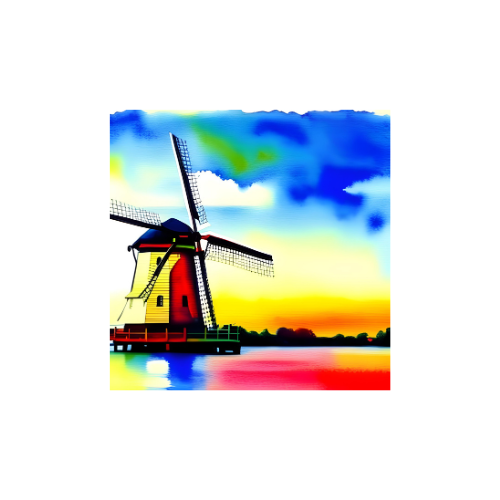
Windmills are used to convert wind power into rotational power. They capture the wind power in their sails or blades and the power is transformed by the machinery to grind flour or pump water, etc.
Wind pumps are a type of windmill. They are used to pump water to drain land for either agricultural or building purposes.
Wind pumps were used in the Netherlands and East Anglia from the late Middle Ages onwards.
In 1586, the Flemish mathematician and engineer, Simon Stevin, patented improvements with gears which led to much more efficient wind pumps.
In 1854, the American engineer, Daniel Halladay, revolutionised wind pumps when he invented the self-regulated farm wind pump. It was designed to change direction with the wind.
Read more about Daniel Halladay from Wikipedia
Until the 1950s, eight to ten bladed wind pumps were used in Spain to raise water from wells for irrigation.
Windmills are associated with The Netherlands although they are actually mainly wind pumps to drain the land. As with the fens, much of the land lies below sea level.
Around 60,000 wind pumps are still used in the United States of America where they are known as weathercocks.
They are used in Africa to provide water for humans and farm animals.
In some other parts of the world such as Nicaragua, a rope pump is used with a wind turbine to pull water up through pipes.
In the Norfolk Broads and the East Anglian Fens in the UK, the wind pumps are usually called windmills or drainage windmills. Most of them have been replaced by pumps powered by diesel or electricity.
Some of the original wind pumps were destroyed, some remain in a derelict state, some are being restored, and some have been restored. They can be seen in their various states throughout the fens.
There is a small smock wind pump at Wicken Fen in Cambridgeshire. It was built in 1912 and is the last wind pump in the fens. It is occasionally in action.
‘Smock’ means it has a wooden tower.
There is also a large smock windmill, Wicken Corn Mill, which was built in 1813.
This windmill is a vertically boarded smock mill in the Cambridgeshire style and is near Ely in Cambridgeshire. It is the only working twelve sided smock mill in the UK.
Read more about the wind mill at Wicken Fen from SPAB (opens in a new tab or window)
These are a few of the restored windmills which are used to mill cereals into bread rather than pump water:-
The world’s only eight sailed windmill is at Heckington in Lincolnshire. It was originally built with five sails in 1830. It is currently waiting to be repaired following storm damage.
Read more about the windmill at Heckington (opens in a new tab or window)
The tallest windmill in the country was built in 1822 and is at Moulton in Lincolnshire:-
Read more about the windmill at Moulton
There are some wind pumps in Norfolk:-
Read more about Norfolk’s wind pumps (opens in a new tab or window)
There are some steam mills in Norfolk:-
Read more about Norfolk’s steam mills (opens in a new tab or window)
There are some water mills in Norfolk:-
Read more about Norfolk’s water mills (opens in a new tab or window)
 The Fens App